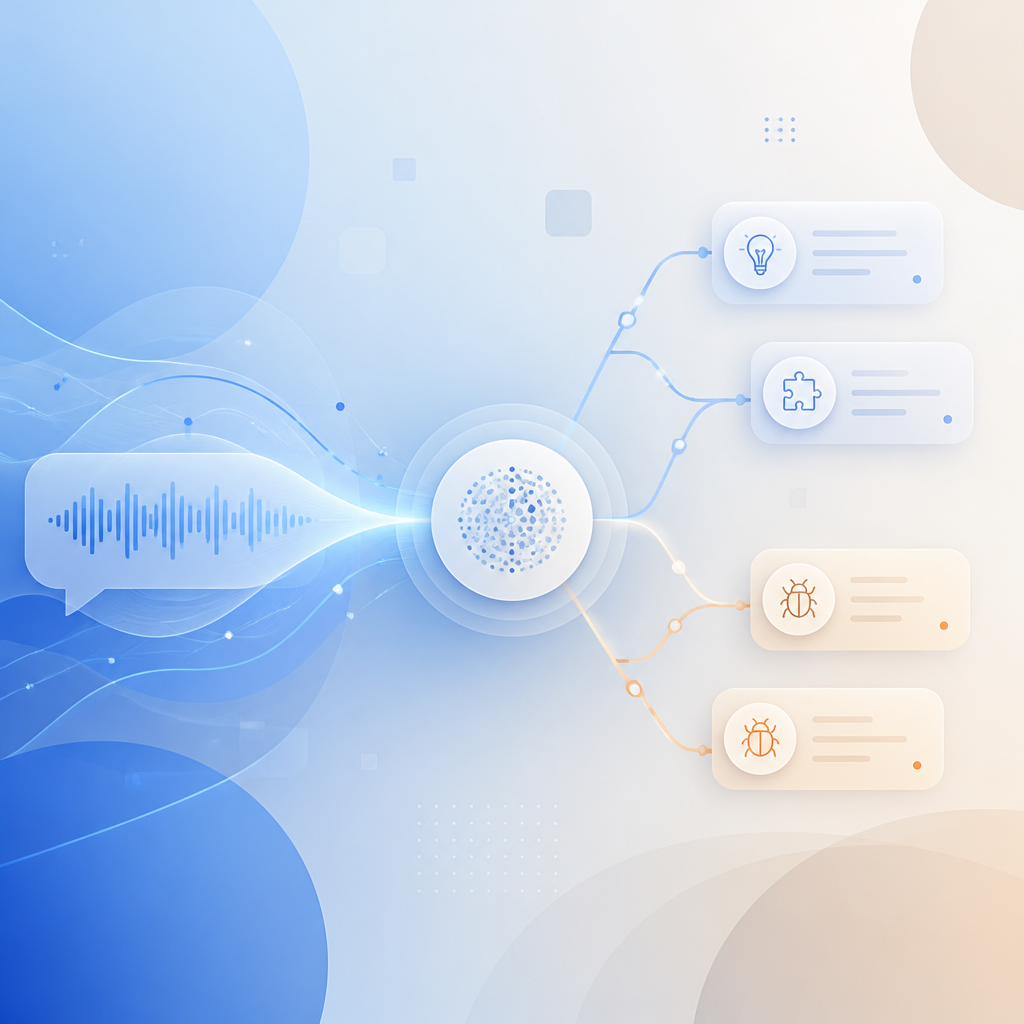
There are three ways to extract feature requests from Gong calls. Gong's own trackers flag keywords you define. Exporting transcripts and running them through an LLM finds requests you didn't anticipate. A connected pipeline does it continuously. Whichever you use, the step that makes it useful is linking each request to the account, its revenue and the matching support tickets — otherwise you end up with a pile of quotes and no way to tell a $5k logo's pet request from something half your ARR is asking for.
Sales teams say "customers keep asking for this" constantly. It's rarely backed by anything you can act on. Gong is sitting on the raw material — you just need a method to turn it into structured, weighted signal.
What does Gong actually expose for this kind of analysis?
Per Gong's own help center (help.gong.io), every recorded call gets a full transcript, speaker-separated and timestamped, plus Gong's native Trackers feature, which flags configured keywords and phrases across calls and surfaces them in a dashboard. Gong also supports transcript export (via the UI for individual calls, and via API for bulk pulls) and a public API that returns call metadata — account, deal stage, participants, duration — alongside the transcript text. That metadata is the hook you'll need later to join a mention back to an account and its ARR.
Confirm these features are still live under the same names before you build a workflow around them — Gong ships product changes frequently, and the help center is the source of truth, not this article.
How do I extract feature requests and competitor mentions from Gong calls automatically?
You do it with one of three methods, in increasing order of effort and completeness: Gong trackers for known keywords, transcript export plus an LLM for everything you didn't think to look for, or a continuous pipeline that runs both automatically and joins the output to revenue and support data. Most teams start with trackers, hit their ceiling within a quarter, and move to the other two.
Method 1: Gong trackers
Set up a tracker for each competitor name and a handful of feature-request phrases ("wish it could," "need the ability to," "does it support"). Gong will flag every call where those terms appear, and you get a dashboard of frequency over time. This takes an afternoon and surfaces nothing you didn't already know to look for. If a prospect says "I need SOC 2 reporting" and you don't have a tracker for "SOC 2," it's invisible. Trackers are a keyword net, not a discovery tool — fine for monitoring known competitors, weak for finding the request nobody flagged yet.
Method 2: Export transcripts and run them through an LLM
Export transcripts in bulk via Gong's API, batch them by week or by account, and run them through an LLM with a structured prompt. This catches requests and complaints in language you never anticipated, because you're not matching keywords — you're asking a model to read the conversation.
The failure mode here is hallucination: a model can "find" a feature request that was never actually said, especially when you ask it to summarize. The fix is to require evidence, not summary. A prompt template that works:
Prompt template:
- "Read this call transcript. Extract every instance where the customer or prospect requests a feature, reports a bug, or mentions a competitor by name."
- "For each instance, return: the verbatim quote, the speaker, the timestamp, and a one-line classification (feature request / bug report / competitor mention)."
- "If you cannot find an exact quote and timestamp, do not include the item."
That last line matters more than the rest of the prompt combined — it's what stops the model from inventing plausible-sounding requests. Anthropic's own prompt engineering guidance (docs.claude.com) makes the same point generally: constrain the model to cite source text rather than paraphrase when accuracy matters more than fluency. Spot-check a sample of outputs against the original transcript before you trust a batch run.
Method 3: A continuous pipeline
Both of the above are snapshots. A pipeline runs the extraction on every new call automatically, applies the same verbatim-quote rule, and — critically — writes the output somewhere it can be joined to other data rather than left in a spreadsheet. This is the only method that scales past a handful of accounts without someone doing manual exports every Friday.
What tools help PMs analyse Gong calls and support tickets for product insights?
You need something that ingests both Gong transcripts and your support tool's tickets, matches them by account, and ranks the combined pattern by revenue — a spreadsheet or a standalone call-analysis tool will do one of those things but not all three. The tools that just surface "top themes from Gong" are solving half the problem; the other half is tying that theme to a dollar figure and a ticket count.
This is where most workflows quietly fail. A sales call asking for SSO and eleven support tickets complaining about SSO are the same underlying problem, but if they live in separate tools they get counted, scored, and prioritized as two unrelated, smaller signals instead of one obvious one.
How do I avoid double-counting and separate prospect noise from customer signal?
Dedupe by account and topic, not by call — the same prospect mentions the same gap on three calls across a sales cycle, and that's one data point, not three. Tag every extracted request with deal stage (prospect vs. existing customer) before it goes anywhere near a priority score, because a prospect asking for a feature to close a deal is a different signal than a paying customer with ARR at risk asking for the same thing. Treat competitor mentions separately again: "they're looking at [Competitor]" is a churn or loss signal, not a feature request, even though it surfaces in the same extraction pass.
Deciding how heavily each of those should weigh in your roadmap is a separate problem — Turning Sales Calls and Support Tickets Into Product Decisions covers that. This article stops at getting the data into a usable, de-duplicated shape.
How do you combine Gong data with support tickets and ARR?
Join on account, not on text similarity — match the Gong call's account field to the same account ID in Salesforce or your CRM, then pull in the account's ARR and open or historical tickets for that same account from your support tool. Once a request is linked to ARR and ticket count, a $400k account asking on a call plus three related tickets outranks ten mentions from trial accounts, by design. Without that join, pattern counting — "this came up 12 times" — has no way to tell those two situations apart, and ends up prioritizing whatever's loudest rather than whatever's worth the most.
What's the step everyone skips?
Routing the pattern to a fix. Most Gong-analysis workflows stop at a dashboard of themes ranked by frequency, which is exactly the "insight without action" trap covered in Insight Tools vs Fixing Tools. A ranked list of what customers asked for on calls is not the same as a scoped ticket in an engineer's queue. If your pipeline ends at the dashboard, you've built a better way to describe the problem you already knew you had.
For how to turn the ranked, revenue-weighted list into actual roadmap decisions, see Turning Sales Calls and Support Tickets Into Product Decisions. For the broader program this should sit inside, see How to Build a Voice of Customer Program. For general-purpose AI feedback analysis beyond Gong specifically, see How to Analyze Customer Feedback at Scale with AI.
Can Gong identify feature requests?
Gong's trackers can flag keyword matches you configure in advance, but Gong does not natively classify a statement as a "feature request" versus a complaint or a casual comment — that classification requires either manual review or a separate LLM pass over the transcript.
How do I export Gong call transcripts?
You can export an individual call's transcript from the call page in the Gong UI, or pull transcripts in bulk via Gong's API, which also returns call metadata like account, deal stage, and participants — confirm current export options in Gong's help center, as UI paths change.
How do you analyse sales calls for product feedback?
Extract verbatim quotes with timestamps using trackers or an LLM prompt that requires source evidence, classify each as feature request, bug report, or competitor mention, then join every item to the account, its ARR, and related support tickets before ranking anything.
Should prospect requests count the same as customer requests?
No — tag deal stage before scoring. A prospect's request is a sales-cycle signal that may reflect what it takes to close a deal; a paying customer's request is tied to retention and expansion, and the two carry different weight in a prioritization decision.
How do you combine Gong data with support tickets?
Match both sources on account ID rather than on keyword or topic similarity, so a call mention and a ticket from the same account are recognized as one pattern. Tools that connect to both Gong and your support platform, like VocxAI, can do this join automatically rather than requiring a manual spreadsheet merge.
See how VocxAI builds this for you
VocxAI is the AI agent that keeps improving your product: it finds the patterns in customer feedback from any tool you use, works out what's wrong in your code, has AI agents build the fix for your approval, then checks whether it worked and acts on what it learns.
Sign up for free