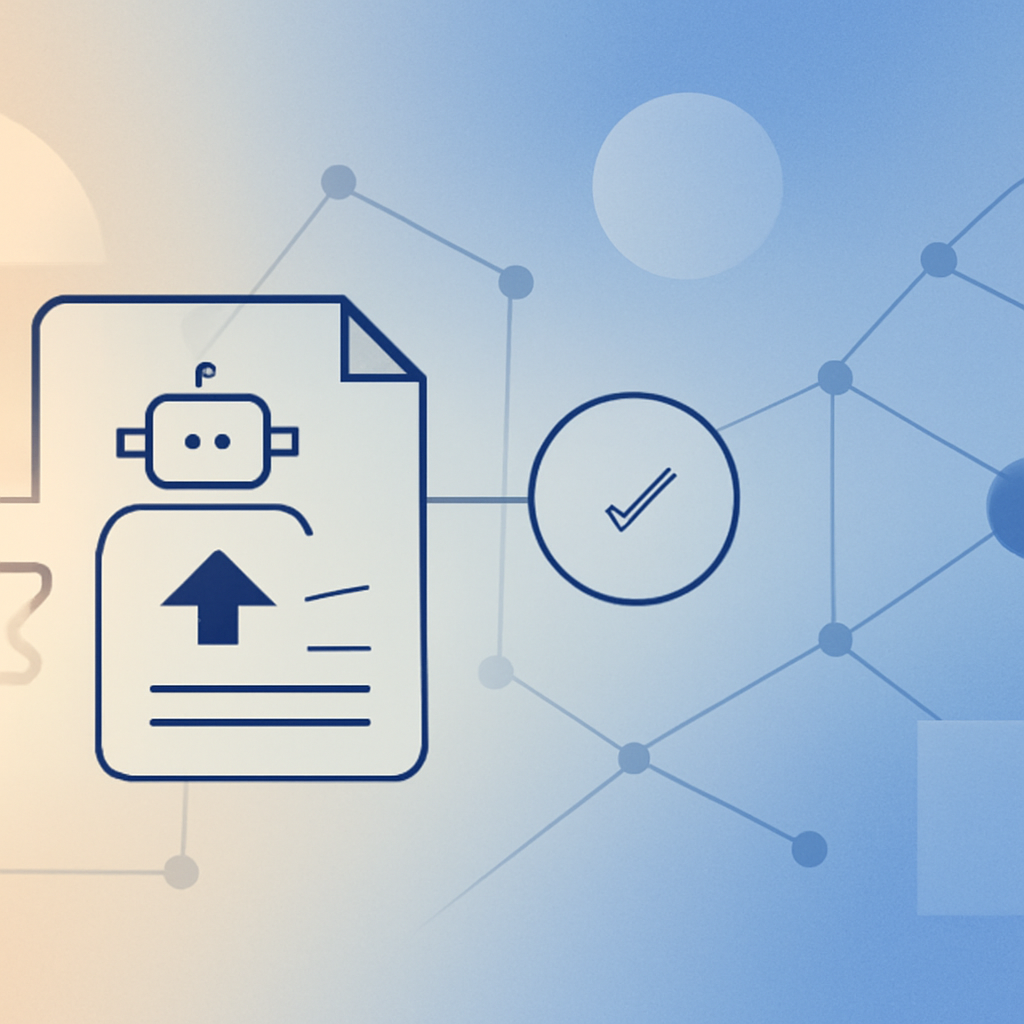
AI agents open pull requests by executing a scoped task in a sandboxed checkout of your repo - editing files, running tests, and pushing a branch through a GitHub App - then surfacing the diff for human review. The safest setups gate the PR behind confidence scoring and security checks so a person approves before anything merges. Nothing about this requires giving an agent write access to main; the agent's entire job ends at "here's a branch and a diff," and a human's job starts at "should this ship."
How does an AI agent actually create a pull request?
The mechanics are less magical than the marketing suggests. A typical pipeline looks like this:
- Scoped task input: the agent receives a ticket, spec, or PRD fragment - not "improve the app," but "add a rate limiter to the /webhooks endpoint per spec section 3."
- Sandboxed checkout: the repo is cloned into an isolated container or ephemeral VM with no access to production credentials, secrets, or other repos.
- Edit and self-test loop: the agent modifies files, runs the existing test suite, and often writes new tests to cover the change. If tests fail, it iterates before ever touching your review queue.
- Branch and push: a feature branch is created and pushed using a scoped GitHub App installation token - not a personal access token with broad org permissions. This matters: GitHub Apps let you grant per-repo, per-permission access (contents, pull requests, checks) instead of a blanket key that can touch everything.
- PR opened with metadata: the PR description includes what changed, why, which tests ran, and a confidence score. This is the artifact a human actually reviews.
No step in this chain includes a merge. The agent's write permission is scoped to opening branches and PRs - merge rights live with humans or with a separate, tightly audited automation gate.
How do you scope a task so it's safe for an agent to touch?
Most bad agent PRs trace back to bad task scoping, not bad models. Agent-safe tasks share a few properties:
- Bounded surface area: a single endpoint, component, or module - not a cross-cutting refactor.
- Explicit acceptance criteria: "given X input, return Y" beats "make search better."
- Existing test coverage: if there's no test harness for the area being touched, the agent is flying blind and so is the reviewer.
- No irreversible side effects: schema migrations, billing logic, and auth flows need tighter scoping or should stay human-authored, at least until your gate process is proven.
This is the same discipline behind good spec-driven development - vague tickets produce vague diffs regardless of who (or what) writes the code.
Where does the human actually approve - Slack, GitHub, or somewhere else?
Human-in-the-loop doesn't mean "someone eventually looks at it." It means a specific, blocking gate with a specific person accountable. Common patterns:
- Slack approval gate: the agent posts the PR link, diff summary, and confidence score to a channel; a reviewer reacts or replies to approve before CI is allowed to run further or before the PR is unlabeled "draft."
- Required review + branch protection: GitHub branch protection rules require at least one human approval and passing checks before merge is even possible - this is enforced at the platform level, not just by convention.
- Staged environments: agent PRs auto-deploy to a preview environment but never to staging or production without a second approval.
- Escalation by confidence: low-confidence PRs route to a senior engineer; high-confidence, low-risk PRs (docs, tests, minor bug fixes) might route to a faster single-approver path.
The point of layering these is that no single failure - a missed Slack message, a distracted reviewer, a permissive branch rule - is enough on its own to let a bad change through.
What do confidence scores and security flags actually check?
"Confidence score" sounds soft, but it should be built from hard signals, not vibes:
- Test pass rate and coverage delta - did the change increase or decrease coverage on touched files?
- Diff size relative to task scope - an agent asked to fix a null check that touches 40 files is a red flag, not a productivity win.
- Static analysis and dependency checks - new dependencies, changed permissions, or patterns matching OWASP Top 10 categories (injection, broken auth, sensitive data exposure) should auto-flag for security review.
- Historical pattern matching - has this agent's past output in this repo required rework? Feed that back into the score.
Model providers like Anthropic increasingly expose reasoning traces or tool-call logs specifically so these checks can be automated rather than left to a reviewer's gut feel.
What should a human reviewer actually check on an agent PR?
Reviewing an agent PR is not the same as reviewing a human PR - the failure modes are different. Check for:
- Scope creep: did the agent touch files or logic outside the stated task?
- Plausible-but-wrong logic: agents are fluent, which makes subtly incorrect code easy to miss on a skim. Read the actual diff, not just the summary.
- Test quality, not just test presence: did it write tests that assert real behavior, or tests that just make coverage numbers look good?
- Hardcoded values and shortcuts: agents under time or token pressure sometimes hardcode a test-passing value instead of solving the general case.
- Dependency and permission changes: anything new in the manifest or config deserves extra scrutiny regardless of confidence score.
This is also where DORA's change failure rate metric earns its keep - track it separately for agent-originated PRs versus human PRs so you have real data on whether your gates are working, not just a feeling that they are.
What guardrails actually prevent a bad agent merge?
Layer these rather than relying on any one of them:
- Branch protection requiring human approval and green CI, enforced at the repo level.
- Scoped GitHub App permissions - no agent identity should have org-wide admin or secrets access.
- A sandbox with no path to production credentials, so a bad agent action can't escalate beyond the PR itself.
- Automatic rollback or feature-flagging for anything that does reach production, so a missed issue is cheap to reverse.
- Rate limits on PR volume per agent per day - a runaway loop opening 50 PRs is a signal something's broken, and your process should catch it before a reviewer does.
How do you keep agent-generated PRs auditable months later?
Auditability isn't optional once agents are shipping regularly - you need to answer "why did this change happen" long after the PR is merged and the context is gone from everyone's head.
- Link every PR to its originating task or spec - the ticket, PRD section, or feedback signal that triggered it.
- Preserve the agent's reasoning trace alongside the diff, not just the final code.
- Record who approved and what they checked - a one-click approval with no notes is barely better than no review.
- Tag commits with agent identity and model version so a regression can be traced to a specific pipeline version, not just "the AI did it."
VocxAI is the AI agent that keeps improving your product: it finds the patterns in customer feedback from any tool you use, works out what's wrong in your code, has AI agents build the fix for your approval, then checks whether it worked and acts on what it learns. That traceability - from the original customer signal through the spec to the merged diff - is what makes agent-generated code defensible in a post-mortem, not just fast to produce.
FAQ
Can an AI agent merge code without review?
Technically yes if you configure it that way, but it's a bad idea outside narrow, low-risk cases (auto-generated docs, dependency bumps with clean CI). Branch protection rules requiring human approval should be the default for anything touching application logic.
How do approval gates work?
An approval gate is a blocking checkpoint - usually enforced via GitHub branch protection or a Slack-based workflow - that prevents merge until a designated human explicitly approves, in addition to passing automated checks like tests and security scans.
Is it safe to let agents touch production repos?
It's safe when the agent's write access is scoped to feature branches via a permissioned GitHub App, the sandbox has no production credentials, and merge to protected branches requires human approval. It's not safe if the agent has direct push access to main or shared secrets.
What does the human reviewer actually check?
Scope creep beyond the stated task, logical correctness (not just plausibility), genuine test quality versus coverage-padding, and any new dependencies or permission changes - the failure modes specific to fluent-but-wrong AI output.
How are agent PRs kept auditable?
By linking each PR to its originating spec or feedback signal, preserving the agent's reasoning trace alongside the code diff, logging who approved and why, and tagging commits with the agent and model version used.
See how VocxAI builds this for you
VocxAI is the AI agent that keeps improving your product: it finds the patterns in customer feedback from any tool you use, works out what's wrong in your code, has AI agents build the fix for your approval, then checks whether it worked and acts on what it learns.
Sign up for free